
Sources for Gardena Previous Residents
Each Gardena source answers a different question about an address history. The Recorder is the legal spine of title. The Assessor anchors the current parcel. Directories and census schedules capture households. Permits and maps date the structures. Probate or obituaries can close out a life trail. Local directory, permit, and Sanborn years stay marked as unknown. Official sources do not publish them.
| Source | Years it covers | Where held | What it shows |
|---|---|---|---|
| Gardena deed index and books | 1850-present | RR/CC Norwalk | Grantor, grantee, instrument, Gardena legal title chain |
| Gardena Assessor current system | Current and recent roll; start not published | LA County Assessor | AIN, situs, value, use, characteristics; owner offline |
| Gardena permits and code files | Digital start not published | Community Development | Gardena project address, applicant, contractor, dates, status |
| Gardena criss-cross and city directories | Exact Gardena years not published | County Library Californiana | Listed occupant or subscriber by name or Gardena address |
| Gardena-area federal census | Decennial schedules through 1950 public | NARA and library databases | Household members, relationships, tenure clues |
| Gardena Sanborn fire-insurance maps | Collection 1867-1999; Gardena edition unknown | Library of Congress and libraries | Footprint, use, materials, old numbering context |
| Gardena probate and obituaries | Case or publication dependent | Superior Court, library, newspapers | Death, heirs, estate endpoint, last known address |
Gardena past residents come into focus through overlap. A deed may name a title party no directory ever lists, while a directory can show a household that holds no recorded title at all. Census enumerators, meanwhile, count people the publisher skipped.
Start With the Gardena Past Residents Parcel
Search the Gardena situs address in PAIS. Save the AIN, property type, year built, use, values, and map link. Owner names do not appear on the public Assessor site. When a current owner is genuinely needed, a district-office counter or Property Data Sales may help. Check whether access permits. Do not swap the AIN for a guessed surname.
The Gardena parcel can change shape. A split, combination, old subdivision, or street-number change may occur. That can make a modern address look unrelated to an older deed. Read the map and legal description before searching backward. Record the current situs, mailing address, city, ZIP, and AIN. Add any lot or block terms in one worksheet.
- AIN
- The ten-digit Assessor Identification Number assigned to the parcel.
- Legal description
- The recorded lot, block, subdivision, metes, or other land description that identifies the property.
- Chain of title
- A sequence of recorded transfers connecting one title party to the next.
- Situs
- The physical location used for the assessed parcel, separate from a mailing address.
Finding past residents in Gardena begins with land identity. Names can wait until the Gardena parcel is stable.
Walk the Gardena Previous Residents Deed Chain Backward
Gardena records sit with Los Angeles County. No real-estate index is on the public web. The RR/CC request service can search or copy a record when you bring a document number, date, or party name. Exploratory chain work belongs at the Norwalk counter. Recorded land records reach back to 1850, and that depth makes the counter and the legal description central to any old-address search.
- Pull the current Gardena parcel facts and AIN from PAIS, then obtain a lawful current owner or known acquisition deed.
- Find the current Gardena owner's deed as grantee and note the grantor, instrument number, recording date, and legal description.
- Search that Gardena grantor backward as grantee, testing individual, trust, corporate, and name variants.
- Use deeds of trust, reconveyances, probate orders, maps, and AIN references to bridge a Gardena split or transfer.
- Repeat until the Gardena chain reaches the desired period, citing recording date and signed date separately when both appear.
Grantor means the party transferring the land. Grantee means the party receiving it. A Gardena chain of title follows land rights, not every person who ever lived at the address, and that distinction keeps past residents research honest.
The recorded-request screen shows the Gardena channel that stands in for an online deed index.
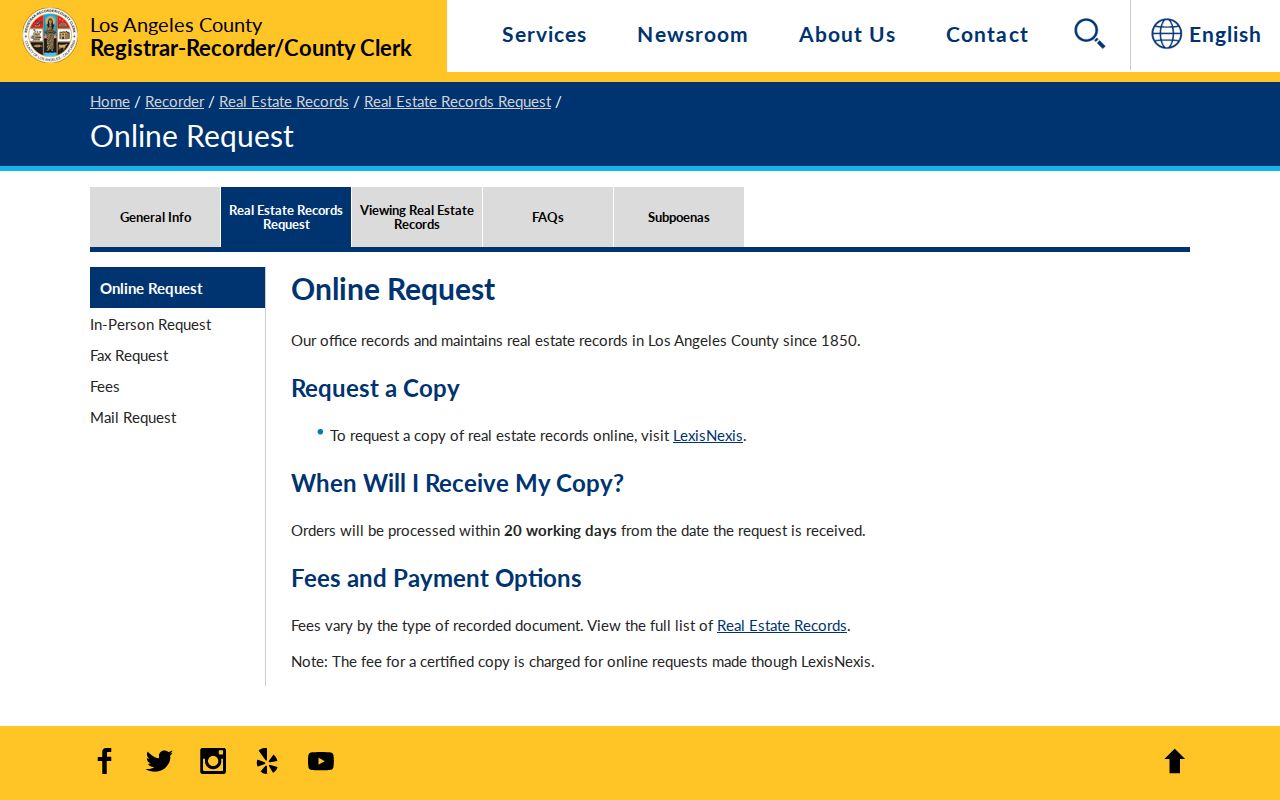
Use the request when the index clue is narrow. Turn to the counter when the chain itself still needs discovering.
Gardena Previous Residents: Legal Descriptions Beat Old Numbers
Street numbers are convenient but fragile. A legal description and the AIN can hold a deed chain together when the street name, postal city, or unit format changes. Search lot, block, subdivision, ranch, and former community terms when a modern number fails. Gardena's pre-incorporation geography includes Moneta and Strawberry Park. Those names belong in a historical query.
Gardena parcel splits and combinations create another trap. Follow old and new AIN references, map revision notes, and the legal description. A quitclaim or family transfer is not a sale. A trust or entity may own the parcel while an individual signs as trustee, officer, or agent. Read the recorded document rather than treating any name format as a settled identity.
Address rule. When a historic Gardena street number fails, keep the parcel in view. Widen the search to lot, block, subdivision, former place name, and legal description.
A modern street directory and a Gardena previous residents trail answer different questions. Never merge them into one undated name list.
Past Gardena Households in Directories
City directories fill the household layer between deeds. Polk-style volumes usually run surname-first. Haines criss-cross volumes work the other way. They can start with a street number and list an occupant or subscriber. The exact Gardena title and year run are not published online, so ask Norwalk Californiana staff for a catalog and shelf check. The Gardena city directory collections page explains how to read a verified volume.
Pair each Gardena directory edition with a federal census schedule from the same era. A directory is selected and publication-based. A census enumerates people under federal rules. A spouse notation, telephone, “wid” mark, or address change can bridge the two. Absence may just mean an unlisted subscriber, a new build, a boundary shift, or wartime removal.
- Capture the Gardena title page, publisher, nominal year, geographic coverage, and abbreviation key.
- Search Gardena surname-first and street-first sections, then transcribe the whole entry and page.
- Compare the next available Gardena edition and record every address, spouse, phone, and descriptor change.
- Match the nearest Gardena public census household, deed, permit, obituary, or probate record.
The goal is not to force every Gardena source into agreement. It is to explain what each one observed.
Gardena Census and 1950 Boundary
Federal law seals each census for 72 years. That makes 1950 the newest schedule anyone can open. A Gardena census page lists who lived in a household and how they were related. It also gives their ages, birthplaces, and other fields the enumerator recorded. Cross-check a directory entry against that schedule and the address usually lines up. Still, a census proves a moment, not a chain of ownership. So it cannot stand in for a deed.
Pre-1950 addresses need wider nets. Search Gardena beside Moneta and Strawberry Park. Add the county geography and any subdivision name attached to the land. One household can sit under the enumerator's place label yet appear in the directory under the publisher's postal label. Compare both labels before concluding the entry belongs elsewhere.
| Gardena directory | Selected listed adults, subscribers, addresses, and publication-year clues. |
|---|---|
| Gardena census | Enumerated household members and relationships at the census date. |
| Gardena deed | Recorded title parties and legal parcel transfer. |
| Gardena probate | Estate, heir, and service-address clues after a death. |
Date a Gardena Previous Residents Structure
A building's age is not a household's age. Gardena Community Development keeps permits, inspections, and code files, though it publishes no start date for its digital coverage. Request an address file by range and category. The Assessor's year-built field reflects assessment practice, so additions and remodels may not show.
Sanborn fire-insurance maps offer another anchor. The Library of Congress collection runs from 1867 to 1999, and it lists no Gardena-specific edition index. Search by place and confirm a sheet covers the parcel. A footprint, use, material, or old street number can steady a property trail when addresses shift.
Track title owner, directory occupant, census household, permit applicant, and tax mailing addressee in separate columns. A dated structure clue explains gaps between past residents. It never makes an applicant an occupant.
When Gardena Previous Residents Disappear
Names drop out of a Gardena directory for many reasons. A move can erase an entry. So can an unlisted phone, a publication gap, or a changed surname. Wartime forced removal or death can erase one too. Treat an obituary or cemetery notice as a lead only. Corroboration should come from vital, probate, deed, or court records. The absence of a name proves nothing about a move.
Probate often closes the trail. A decedent's petition, notice, or proof of service can name heirs. So can a recorded transfer, and either can give their mailing addresses. LA Superior Court holds the case file. The County Clerk does not. A court index may list a case. Its documents may stay restricted or need a paid copy.
Pair the LA Superior Court case search with the library's Gardena newspaper aids. Obituary finding aids there help too. Date every clue as you collect it. Label each one a death fact, an estate filing, a transfer, or a publication notice.
Gardena Previous Residents and Former Place Names
Gardena incorporated in 1930. Older residents and parcels may appear under different labels. Try Moneta, Strawberry Park, a ranch, a subdivision, or plain county geography. Library custody shifted too. The Gardena branch joined the County Library system in 1914. It later moved into the Los Angeles City Library system. It returned in 1951. Those changes shape catalog terms and where a past volume sits today.
Search the former place names before calling a previous resident record missing. Then bridge what you find to the current AIN. You can also use the deed's legal description, census geography, or a street map. One parcel of land can carry different postal, municipal, and historical labels at once. It is still the same land.